
Ethel Sargant & Margaret Crosfield
She took her field notes on suffragette notepaper. Her colleague was the first female Fellow of the Geological Society, by alphabetical accident.
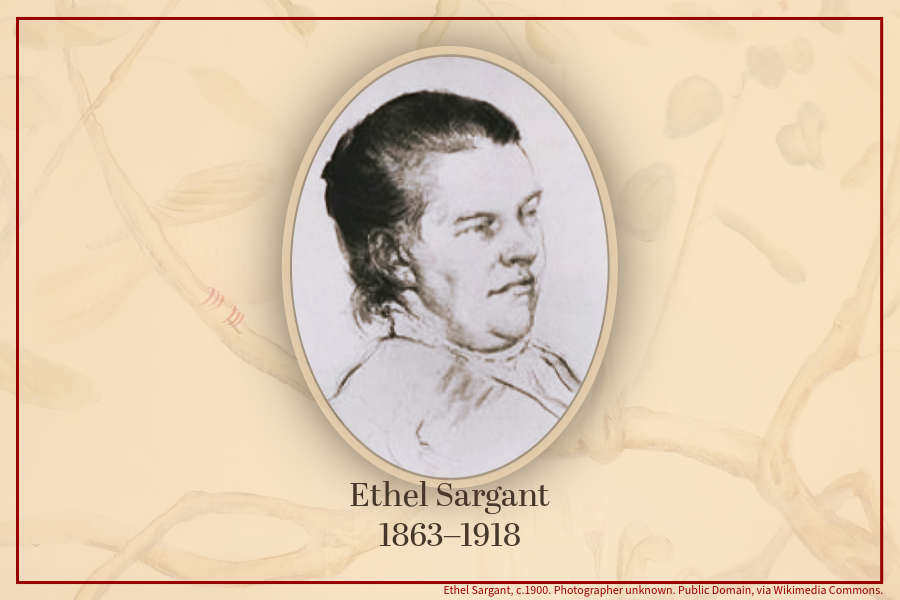
Ethel Sargant and Margaret Crosfield were pioneering women in science whose careers broke new ground in botany and geology respectively, and both were members of the University Women’s Club. Sargant became the first woman to serve on the council of the Linnean Society and the first woman to preside over a section of the British Association for the Advancement of Science. Crosfield became the first female Fellow of the Geological Society of London. Between them, they helped establish that women belonged in British science, at the highest levels and on equal terms.
Ethel Sargant FLS (1863–1918)
Born in London in 1863, Ethel Sargant studied at Girton College, Cambridge, graduating in 1885. Like so many women of her generation, she passed her examinations and was not awarded the degree. She went on to study research methodologies at Kew Gardens and visited leading botanical laboratories across Europe, before establishing her own private research laboratory, first at her family home in Reigate, later near Girton — because the university laboratories she needed were simply not available to women.
From that private laboratory she produced research of genuine significance. Her work on plant cytology and morphology, particularly on the anatomy of seedlings and the origins of monocotyledons, contributed substantially to the field and earned her the respect of the scientific establishment, even as that establishment kept its doors largely closed to her. In December 1904 she was elected one of the first women Fellows of the Linnean Society of London, and went on to become the first woman to serve on the Society’s council. In 1913 she was elected President of the Botany Section of the British Association for the Advancement of Science, the first woman to preside over any section of the Association. That same year she was elected an Honorary Fellow of Girton College, and became President of the British Federation of University Women, a post she held until her death in 1918.
The 100th meeting of the Cambridge Heretics Society, a group formed to promote open, sceptical discussion of all subjects, religious and philosophical, was held at her home. She was, in every sense, a woman who created space for ideas when the institutions of her day refused to.
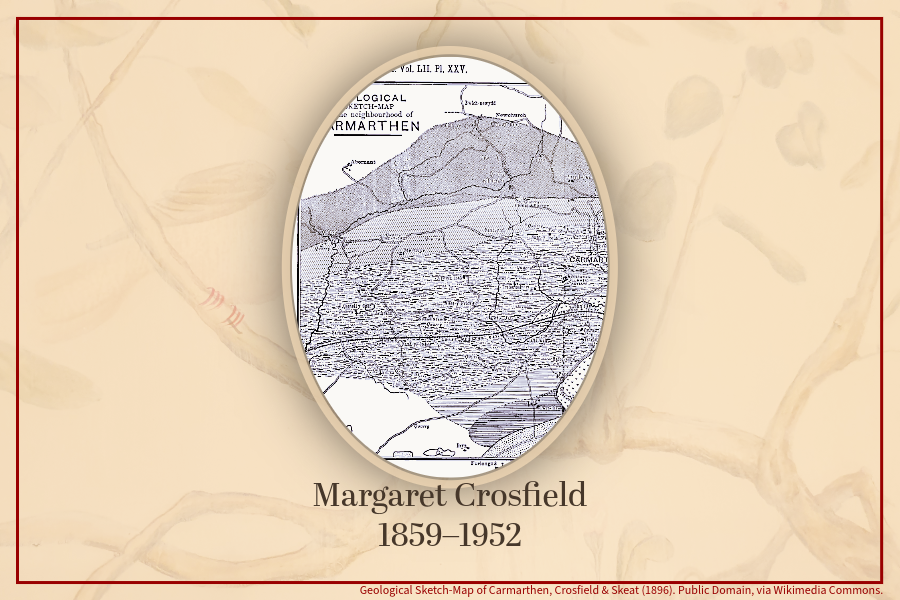
Margaret Crosfield FGS (1859–1952)
Margaret Chorley Crosfield was born in Reigate in 1859 and educated at The Mount School, York — one of the first schools in Britain to send girls to university. She began studying at Newnham College, Cambridge in 1879, though illness interrupted her studies and she returned to complete them a decade later, specialising entirely in geology.
She joined the Geologists’ Association in 1892 and devoted the following decades to fieldwork and research, publishing significant papers on Welsh and Shropshire stratigraphy in collaboration with fellow Newnham geologists Ethel Skeat and Ethel Woods, and conducting detailed work on the Wenlock Limestone of Shropshire with Mary Johnston. Her field notes were meticulous, her specimen collections extensive, and some of those field notes, it is now known, were written on suffragette notepaper. Her scientific work and her political convictions were never separate things.
On 21 May 1919, she became, due to alphabetical primacy, the first of the first eight women to be elected Fellows of the Geological Society of London, the first female Fellow in the Society’s history, by virtue of her surname beginning with C. She served on the Geologists’ Association Council and as its librarian from 1919 to 1923, donated her specimen collections to institutions including the Natural History Museum and the British Geological Survey, and continued contributing to local education in Reigate as a school governor and member of the Borough Council Education Committee. She lived to the age of 93.
Together, Ethel Sargant and Margaret Crosfield represent something that runs throughout the history of the University Women’s Club: the conviction that women’s intellectual life — whether in a laboratory, a field quarry, or a committee room — was not a concession to be granted, but a right to be claimed.
Today, the UWC’s membership continues to include scientists, researchers and academics carrying that tradition forward.
This piece is part of the University Women’s Club’s 140th anniversary series. Members can read the full archival account of these women in the Members’ Portal.