
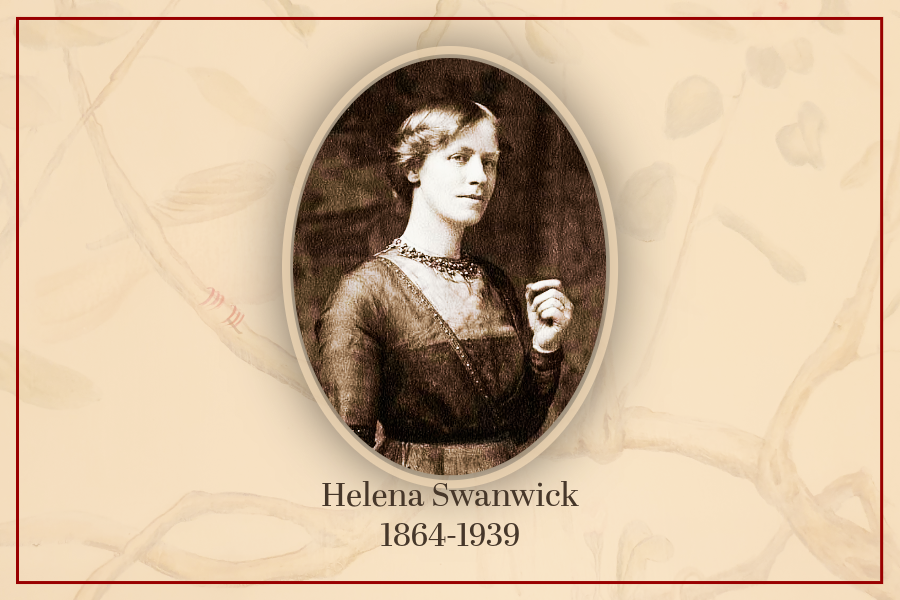
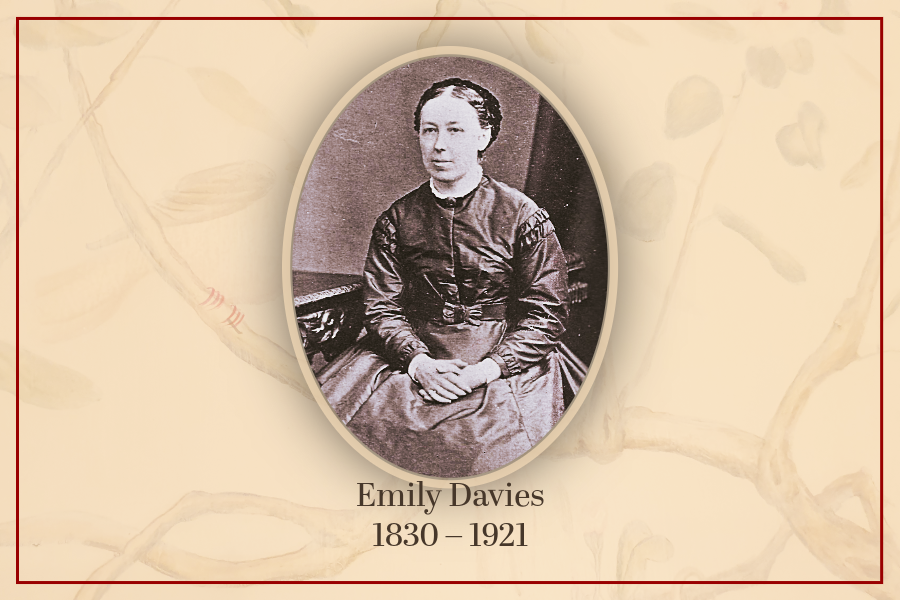
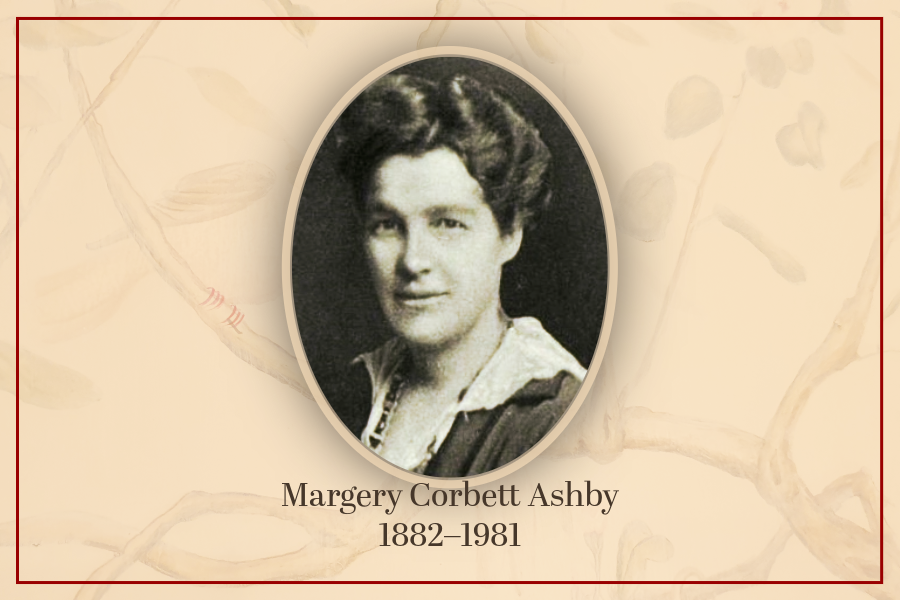
Emily Davies, Helena Swanwick & Margery Corbett Ashby
Suffrage and Public Life at the University Women’s Club
Emily Davies, Helena Swanwick and Margery Corbett Ashby rank among the most consequential women in British public life, and all three were connected to the University Women’s Club. Davies devoted her life to securing women’s right to equal education, co-founding Girton College, Cambridge in 1869. Swanwick edited the NUWSS suffrage journal, chaired the Women’s International League for Peace, and represented Britain at the League of Nations. Corbett Ashby led the International Woman Suffrage Alliance for twenty-three years and was still attending Women’s Day of Action events at the age of 98. Between them, their active public careers span more than a century.
Emily Davies (1830–1921). Born in Southampton in 1830, Davies received the limited education considered appropriate for a middle-class girl of her era, while her brothers attended public school and Cambridge. That contrast shaped everything that followed. In 1866 she published The Higher Education of Women, making the case for a residential college that would educate women to university level on exactly the same terms as men, not a lesser curriculum, not special treatment, but equal standing. She co-founded Girton College in 1869, was responsible for University College London admitting women to classes for the first time in 1870, and served on the London School Board, one of the first women to hold elected public office in Britain. She played a key role in the 1866 women’s suffrage petition to Parliament, helping arrange its printing and delivery, and handing it personally to MP John Stuart Mill. She remained active in the suffrage movement until her death at ninety-one. Cambridge did not admit women to full membership until 1948, twenty-seven years after she died.
Helena Swanwick (1864–1939) was born Helena Sickert in Munich, the sister of the painter Walter Sickert. After studying at Girton College, Cambridge, she moved to Manchester, where she wrote for the Manchester Guardian and became active in feminist and suffrage circles. She joined the North of England Suffrage Society in 1905 and became editor of the NUWSS’s weekly journal The Common Cause from 1909 to 1912. When war came in 1914, she channelled her energies into opposing it, joining the Union of Democratic Control, chairing the Women’s International League for Peace from 1915 to 1922, and representing Britain as a delegate to the League of Nations in 1924 and 1929. Her portrait appears on the plinth of the statue of Millicent Fawcett in Parliament Square, unveiled in 2018 alongside fifty-eight other suffrage supporters. Her autobiography, I Have Been Young (1935), remains one of the most compelling accounts of the non-militant suffrage movement. She received the Companion of Honour for her work for peace and women’s enfranchisement.
Dame Margery Corbett Ashby DBE (1882–1981) studied classics at Newnham College, Cambridge, before becoming one of the most significant figures in the international suffrage movement. In 1904 she helped found the International Woman Suffrage Alliance, and from 1907 served as Secretary of the National Union of Women’s Suffrage Societies. In 1923 she became President of the International Woman Suffrage Alliance, a position she held for twenty-three years, until 1946. She stood for Parliament seven times as a Liberal candidate, always in unwinnable seats, always to advance the cause. She was a delegate to the Geneva Disarmament Conference, from which she resigned in 1935 in protest at the government’s failure to support disarmament. She helped found the British Townswomen’s Guilds and remained active in public life well into old age. She died in 1981, aged 99.
Together, Emily Davies, Helena Swanwick and Margery Corbett Ashby understood that education, suffrage and international peace were not separate causes but a single argument: that women belonged fully in public life, at every level and in every arena. Today, the University Women’s Club counts barristers, solicitors, policy advocates and public figures among its members, continuing, in their own ways, to shape what is possible.
This piece is part of the University Women’s Club’s 140th anniversary series. Members can read the full archival account of these women in the Members’ Portal.