
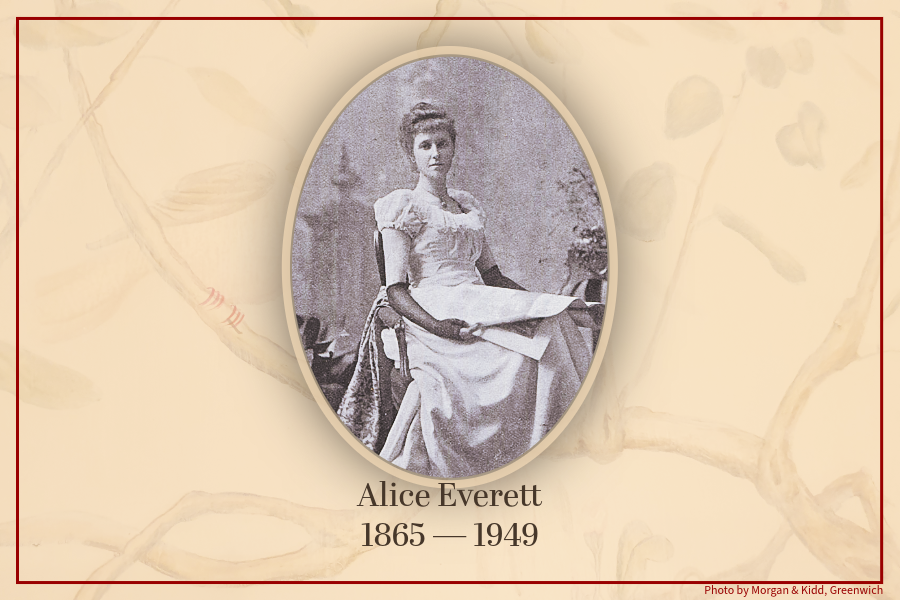
Alice Everett – Astronomer, Physicist & Television Pioneer
Connected to the University Women’s Club since 1890
Alice Everett was an astronomer, physicist and television pioneer whose career spanned three entirely different fields of science, and who excelled at every one of them. A University Women’s Club member since 1890, Everett joined the Club the same year she became the first woman to work at the Royal Observatory Greenwich. What followed was one of the most remarkable and varied scientific careers of her era.
Born in 1865, Alice Everett passed the Cambridge Mathematical Tripos — one of the most demanding examinations in the country, and was ranked as a Senior Optime, equivalent to a Second Class degree. As a woman, Cambridge did not award her the degree.
In 1890 she secured a position at the Royal Observatory Greenwich, becoming the first woman to work there. Her role was as a “Lady Computer”, hired at the lowest civil service wage available, regardless of her qualifications, to photograph stars and calculate coordinates as part of the international Carte du Ciel project to map the entire sky. When the programme wound down and better-paid opportunities failed to materialise for women, she moved to the Potsdam Astrophysical Observatory in Germany — becoming the first woman to work at an observatory there too — before a spell at Vassar College in America.
Frustrated by the lack of career prospects for women in astronomy, she changed direction entirely. She retrained in optics and in 1917, partly due to the wartime shortage of male scientists, secured a position at the National Physical Laboratory, where she remained until retirement in 1925.
Most remarkably of all, retirement did not slow her down. She became involved in the nascent field of television broadcasting, working with the Baird Television Company. She may have been present at John Logie Baird’s demonstration of the first television image in January 1926, and in 1933 co-applied with Baird for a joint patent in television optics. She was a founding member of the Television Society, now the Royal Television Society.
In 2023, asteroid 50727 was named Aliceverett in her honour, a fitting recognition for a woman whose contributions to science spanned the stars and the screen.
The story of Alice Everett as astronomer and television pioneer is a reminder that the women of the University Women’s Club have always refused to be defined by what the world told them they could or couldn’t do. Today, the Club’s membership continues that tradition, counting scientists, researchers and innovators among those who call it home.
This piece is part of the University Women’s Club’s 140th anniversary series. Members can read the full archival account of these women in the Members’ Portal.